
Adopting a validation development process and a V-model, all software components and architecture versions will rely on the outcomes of the end user requirements assessment. Development circles will be identified and followed to deliver the project’s objective and to ensure proper and safe functionalities. All activities within the project can be summarized into the following categories based on their objectives and topics:
Activity 1 “Project coordination & Management”,
Activity 2 “User requirements and operational scenarios”,
Activity 3 “Autonomous surveillance of remote areas”,
Activity 4 “Enhanced operational capabilities and migration services”,
Activity 5 “System integration and pilot demonstration and validation” and
Activity 6 “Impact creation and exploitation activities”.
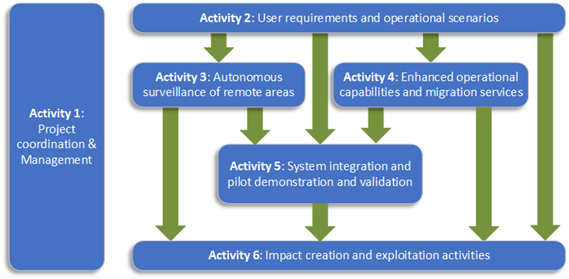
The interconnections between the REACTION Activities are provided in the following Figure as a graphical depiction (Pert chart) while the structure for each activity along with the descriptions is provided in details below.
- Activity 1: “Project Coordination & Management”
Objectives: The primary objectives of the activity are to manage the action in accordance with time and budget agreements as set in the Award Decision; coordinate the activities and ensure scientific and non-scientific dialogue across the consortium; monitor the scientific and technical progress; monitor the data and IPR management plan, coordinate any procurement process and travel arrangements.
- Activity 2: “User Requirements and Operational Scenarios”
The main objective of the activity is to identify the operational, security, ethical and legal requirements of the Border Authorities and Agencies concerning the defined Pilot use cases. Use cases will be specified considering standard formats and common operational activities. Based on the analysis performed, a set of operational, security, ethical and legal requirements will be defined.
- Activity 3: “Autonomous surveillance of remote areas”
In this activity, all related sub-activities will be carried out by the technical/academic partners to enable the autonomous surveillance of remote border areas through UxV. The goal is to adapt equipment and tools such as UxV and sensors, mission planning and resource optimal allocation software for the specific task of autonomous border surveillance. This will provide the system’s module responsible for optimally guiding available UxV resources to remote border areas with a high probability of irregular migration activities and areas that are hard to reach for regular surveillance. Moreover, this activity will ensure the ideal equipment procurement and integration with the software tools.
- Activity 4: “Enhanced operational capabilities and migration services”
The core objective of the Activity is to develop novel functionalities towards delivering an autonomous surveillance system that relies on Unmanned Aerial Vehicles. Hence, improved detection capabilities, novel fusion schemes and innovative situation awareness models will complement a Command-and-Control unit and its current capacities.
- Activity 5: “System integration and pilot demonstration and validation”
Activity’s 5 goals are twofold. On the one hand it aims at integrating large quantities of heterogeneous data derived from the various system’s sensors that will then be forwarded to REACTION command and control system, providing an effective and fast situational overview to the operators, supporting them in their daily functions and decisions. A basic integration component is the Interoperability Layer that will be based on both EUROSUR and CISE widely accepted information exchange models, which will ensure seamless integration and interoperability of the various system’s assets with the envisioned C2. On the other hand, the activity will also host all tasks relevant to the validation of the solution, including the procurement of equipment, planning and the field deployment of the REACTION platform, engaging the competent authorities for the user evaluation.
- Activity 6: “Impact creation and exploitation activities”
The main goal of this activity is to maximize the impact and sustainability of REACTION in the field of border management, by using the knowledge arising from this action efficiently and for the benefit of the Border and Migration Authorities. More specifically, the impact and exploitation strategy consist of the following: communication and dissemination activities, analysis of current market conditions, creation and adoption of an exploitation plan and, lastly, organization of events to analyze and discuss the stakeholder’s needs and to raise awareness of the action’s results among them.